
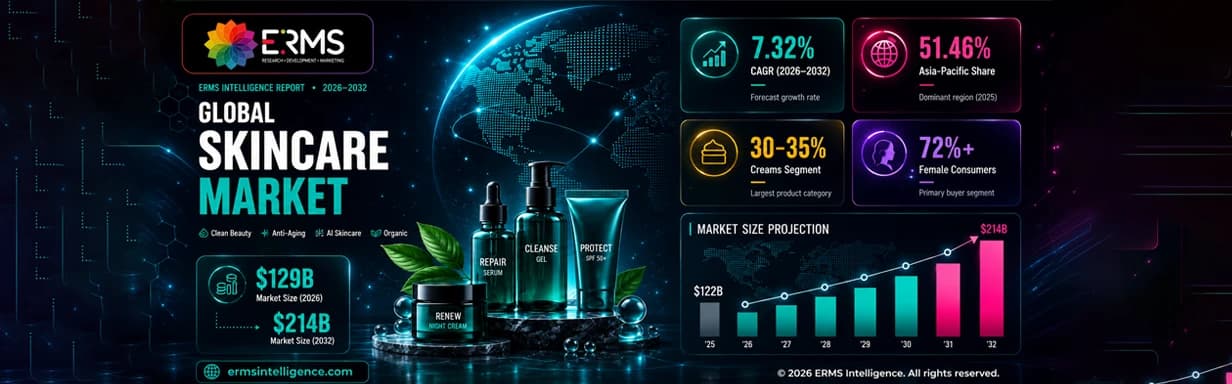
The global skincare market is valued at USD 129.11 billion in 2026 and projected to reach USD 214 billion by 2032 at a 7.32% CAGR. Driven by clean beauty, anti-aging demand, and AI-powered personalization — here is what is shaping the industry through 2032.
Overview of the Global Skincare Market
The global skincare market is experiencing strong and consistent growth, driven by shifting consumer preferences, rising awareness of skin health, and rapid technological advancement in beauty formulations. Consumers across the world are increasingly treating skincare not merely as a cosmetic habit but as a fundamental component of everyday wellness and preventive health care.
According to Fortune Business Insights, the global skincare market was valued at USD 122.11 billion in 2025 and is projected to reach USD 129.11 billion in 2026, growing further to approximately USD 214 billion by 2032, at a CAGR of 7.32% during the forecast period (2026–2032).
This impressive growth is primarily fueled by three converging factors — the widespread adoption of organic and clean beauty products, an increasing global demand for anti-aging solutions, and the rise of high-tech, dermatologist-backed skincare formulations that deliver visible, science-validated results.
Key Market Growth Drivers
1. Organic and Clean Beauty Adoption
One of the most powerful trends reshaping the skincare product market is the strong and growing consumer preference for organic, natural, and clean-label formulations. As consumers become more knowledgeable about skincare ingredients and their effects on the body, there is a clear and decisive shift away from products containing synthetic chemicals, parabens, and artificial additives.
This growing awareness is driving demand for skincare products containing proven actives such as:
- Hyaluronic acid — known for deep skin hydration and moisture retention
- Antioxidants (Vitamin C, niacinamide, Vitamin E) — valued for skin brightening and protection against environmental damage
- Retinol — widely recognized for its anti-aging, cell-renewal, and collagen-boosting effects
Natural ingredients derived from plant sources such as leaves, roots, and botanical extracts are also gaining preference, as consumers consider them safer and less likely to cause harmful side effects compared to synthetic alternatives. This shift is one of the most reliable long-term growth drivers across the global skincare market.
2. Rising Anti-Aging Demand
The global demand for anti-aging skincare products continues to expand steadily, driven by aging populations across North America, Europe, and parts of Asia Pacific. Consumers are actively seeking products that address wrinkles, fine lines, skin firmness, hyperpigmentation, and loss of skin elasticity — concerns that intensify with age.
Anti-aging creams, serums, eye treatments, and advanced retinoid formulations represent some of the highest-margin product categories within the broader skincare industry, and this demand shows no signs of slowing through 2032.
3. AI-Powered and High-Tech Skincare Innovation
Innovation and advancement in technology within the beauty and personal care industry are playing an increasingly important role in market expansion. The development of artificial intelligence (AI) and IT-based skin diagnostic devices that offer personalized skin nourishment solutions is gaining significant traction among consumers globally.
These AI-powered tools — available through smartphones, smart mirrors, and dedicated skincare devices — analyze individual skin type, hydration levels, pore condition, and pigmentation to deliver customized product recommendations and skincare regimens. Techno-savvy consumers are enthusiastically exploring these new-generation devices, and their widespread adoption is expected to meaningfully boost overall skincare market growth through 2026 and beyond.
Dermatologist-backed formulations that combine clinical-grade active ingredients with consumer-friendly textures are also gaining share as consumers seek products that offer measurable, proven results rather than cosmetic promises alone.
4. Changing Lifestyles and Increasing Consumer Spending on Premium Products
Changing lifestyles and rising consumer spending on premium beauty products are expected to be significant drivers of skincare market expansion through 2032. As disposable incomes grow — particularly among urban working populations in Asia, Latin America, and emerging markets — consumers are willing to invest more in quality skincare products that deliver noticeable improvements to skin health and appearance.
Self-care products such as creams, powders, and lotions are now integral to daily routines worldwide. These products are routinely used for hydrating, moisturizing, cleansing, and maintaining overall skin quality. Beauty products in this category offer measurable advantages such as softening the skin, revitalizing skin cells, and providing a fresh, healthy appearance that builds confidence in daily life.
5. Rising Skin Concerns Caused by Environmental Factors
Rising skin concerns — including dullness, dark spots, uneven skin tone, tanning, and scars caused by prolonged sun exposure and urban pollution — have meaningfully enhanced global demand for skin nourishment and correction products. Skincare solutions addressing these concerns, such as skin-brightening scrubs, vitamin C serums, toners, and targeted spot-treatment creams, are particularly popular among the younger consumer demographic (Gen Z and Millennials), who are among the most engaged and frequent skincare buyers globally.
Market Segmentation
By Product Type — Creams Lead the Market
Among all skincare product categories, creams hold the dominant market position, representing approximately 30–35% of total global market revenue. The sustained leadership of the creams segment is a direct reflection of its exceptional versatility across a wide range of consumer needs:
- Anti-aging creams that target wrinkles, fine lines, and loss of skin elasticity
- Moisturizing creams that strengthen the skin barrier and maintain daily hydration
- Pollution-protection creams that shield urban skin from environmental stressors
- Brightening creams that address hyperpigmentation, dark spots, and uneven skin tone
Lotions, serums, scrubs, toners, sunscreens, and powders make up the remainder of the product mix, with serums being the fastest-growing sub-segment due to their concentrated active ingredient content and visible efficacy results.
By Gender — Women Lead, Male Grooming Rises Rapidly
Women are the primary consumer group in the global skincare market, accounting for over 72% of total market revenue in 2025. Women's higher engagement with multi-step skincare routines, broader product category adoption, and stronger inclination to invest in premium formulations firmly establish them as the market's core consumer base.
However, the male grooming and skincare segment is emerging as one of the most significant growth opportunities in the broader market. Changing lifestyles, increasing appearance consciousness among men, the cultural normalization of male grooming, and an expanding range of male-specific and gender-neutral skincare product lines are collectively driving a meaningful uptick in male skincare adoption. Men are progressively incorporating cleansers, moisturizers, eye creams, and SPF products into their daily routines — a behavioral shift that is expected to accelerate through 2032.
Regional Analysis
Asia-Pacific — The Clear Market Leader
Asia-Pacific dominates the global skincare market, commanding 51.46% of total global market share in 2025, driven by the rapid growth of the working-class population, rising personal care awareness, and strong demand across key markets including China, India, Japan, and South Korea.
The region benefits from deep-rooted cultural traditions of skincare and personal grooming, a rapidly expanding middle class with increasing purchasing power, and a vibrant e-commerce ecosystem that has made premium skincare products accessible to a far broader consumer base than ever before. The K-beauty movement originating from South Korea continues to set global skincare trends, driving innovation in formulation, packaging, and multi-step routine adoption worldwide.
North America is projected to register the fastest CAGR among developed regions through 2032, driven by growing demand for clinically validated, clean-label, and dermatologist-endorsed formulations.
Emerging Trends in the Skincare Market
Vegan and Plant-Based Skincare
Rising awareness about animal welfare has encouraged a growing segment of consumers to actively seek out vegan skincare products made entirely from plant-based ingredients — free from animal-derived components and not tested on animals. This ethical consumer shift is particularly pronounced among younger demographics in North America and Europe.
In response, many skincare companies are incorporating natural and plant-derived elements into their formulations and promoting products under labels such as "organic," "natural," and "vegan" to attract the expanding base of eco-conscious consumers.
Eco-Friendly and Sustainable Packaging
Alongside ingredient transparency, sustainable packaging has become a key purchase driver for environmentally conscious skincare consumers. Brands are responding with initiatives including recyclable and refillable containers, biodegradable packaging materials, and reduced-plastic product formats. Companies that credibly communicate their sustainability commitments through both their formulations and their packaging are gaining a meaningful competitive advantage in premium market segments.
Market Challenges and Restraints
Despite the market's strong growth trajectory, several factors present genuine challenges that brands and investors in the global skincare market must navigate carefully.
Risk of Adverse Skin Reactions
Long-term or improper use of skincare products can in some cases cause unwanted effects including skin irritation, burning sensations, redness, discoloration, and in some instances premature skin aging from over-exfoliation or misuse of active ingredients. Certain formulation components may trigger allergic reactions or acne in sensitive skin types, and excessive use of specific products may lead to more significant skin issues over time. These risks can create hesitancy among some consumer groups, limiting purchase frequency and trial of new products.
Highly Fragmented and Competitive Market
The global skincare market is highly fragmented, with a large number of local, regional, and international brands competing across all price points and channels. Many consumers make purchase decisions based primarily on brand reputation rather than a thorough evaluation of ingredient suitability for their individual skin type — a behavioral pattern that can result in suboptimal outcomes for consumers and reputational risk for brands.
The large number of players in the market, combined with the low barriers to entry for smaller and private-label brands, creates ongoing competitive pressure on pricing, shelf space, and consumer attention. Successfully differentiating in this environment requires consistent investment in brand building, formulation innovation, clinical substantiation, and digital marketing.
Frequently Asked Questions (FAQ)
Q: What is the size of the global skincare market in 2026?
A: The global skincare market is valued at approximately USD 129.11 billion in 2026, according to Fortune Business Insights.
Q: What is the projected CAGR of the skincare market from 2026 to 2032?
A: The global skincare market is projected to grow at a CAGR of 7.32% from 2026 to 2032.
Q: Which region dominates the global skincare market?
A: Asia-Pacific leads the global skincare market with a 51.46% market share in 2025, driven by strong demand in China, India, Japan, and South Korea.
Q: Which skincare product segment has the largest market share?
A: Creams hold the dominant position, accounting for approximately 30–35% of total global skincare market revenue, due to their versatility across moisturizing, anti-aging, brightening, and protection needs.
Q: What are the key growth drivers for the skincare market?
A: The primary growth drivers include organic and clean beauty adoption, anti-aging product demand, AI-powered personalized skincare innovation, rising consumer spending on premium beauty, and growing skin concerns caused by environmental factors.
Q: Why is the men's grooming segment growing?
A: Changing lifestyles, increasing male appearance consciousness, the normalization of grooming culture, and the availability of dedicated male skincare product lines are driving the rapid expansion of the men's grooming segment globally.
Q: Are natural and vegan skincare products a significant market trend?
A: Yes. Rising consumer awareness of the potential side effects of synthetic chemicals and growing concern for animal welfare are driving strong demand for natural, organic, and vegan skincare formulations — one of the most durable growth trends through 2032.
About ERMS Intelligence
This market analysis is published by ERMS Intelligence, a global market research and industry intelligence firm specializing in beauty and personal care, healthcare, technology, and industrial sector analysis. We provide custom research reports, competitive intelligence, and strategic market forecasts for businesses and investors across 40+ countries.
📊 Explore our full Global Skincare Market Report with segment-level forecasts, company profiles, and regional deep-dives.
🌐 Visit: www.ermsintelligence.com 📩 Email: contact@ermsintelligence.com 📞 Phone: +91 9174601305
Looking Ahead
Stay tuned for more updates on this topic as we continue to monitor market trends and technological advancements.